
24.06.2026
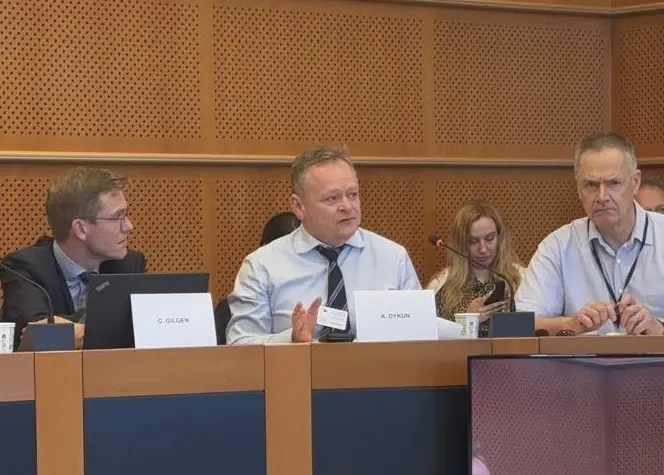
On 23 June, the forum “2026 Roads to Integration: Mapping the Economic and Environmental Future of Ukrainian Agriculture” took place at the European Parliament in Brussels. The event was organised by the Forum for the Future of Agriculture at the initiative of the Ukrainian Agri Council (UAC) and the German-Ukrainian Agricultural Policy Dialogue. It brought together representatives of the European Parliament, the European Commission, the Government of Ukraine, the Mission of Ukraine to the EU, the German Government, Ukrainian agricultural associations, European think tanks, research institutions and business.
The forum focused on what Ukraine’s agricultural integration into the EU should look like in order to become part of Europe’s long-term food, economic and environmental strategy.
Andrii Dykun, Chairman of the Ukrainian Agri Council, emphasised that Ukrainian farmers are committed to EU integration. However, this process must be based on realistic calculations and take into account the conditions in which Ukraine’s agricultural sector has been operating for the fifth year: war, shelling, field fires, risks to port infrastructure, logistics costs, water shortages and uncertainty over the future rules of the EU Common Agricultural Policy.
“We are not against European standards. But a Ukrainian farmer must clearly understand how much European integration will cost their farm. For this, we need professional calculations and an honest expert discussion,” said Andrii Dykun.
According to him, Ukraine is entering the negotiation process as a country that, despite the war, continues to maintain production, exports and its role in global food security. Therefore, Ukrainian agriculture should not be viewed as a “problem for the market”, but as part of Europe’s common food, economic and security resilience.
Member of the European Parliament Paulo do Nascimento Cabral described Ukraine as an agricultural powerhouse and noted that its integration into the EU should be approached pragmatically — with preparation, transitional arrangements, and careful consideration of differences in agricultural structures, market integration, competition, and the potential impact on the Common Agricultural Policy. At the same time, he stressed that the debate should not focus solely on the cost of enlargement, but also on its strategic benefits. According to him, Ukraine can become an even more important partner for the EU in strengthening food security, strategic autonomy, and the resilience of European food systems.

Janez Potočnik, Chair of ForumforAg and Chairman of the RISE Foundation, underlined that decisions on Ukraine are not only about trade or negotiation procedures, but about what kind of Europe should be built for future generations. According to him, integration is not simply about harmonising legislation or opening markets, but about a deep transformation of institutions, the economy and mindsets.
He also stressed that agricultural policy should not oppose productivity and the environment. The future of Ukrainian and European agriculture must combine competitiveness, resilience and environmental responsibility, while the integration of Ukraine’s agricultural sector should strengthen not only Ukraine, but also the resilience, sustainability and prosperity of Europe as a whole.
Tassos Haniotis, Special Advisor for Sustainable Productivity at the Forum for the Future of Agriculture and Senior Guest Research Scholar at IIASA, described the discussion as a transition “from myths to reality”. He pointed out that the integration of Ukrainian agriculture into the EU is taking place at a time when European agricultural policy itself is changing — from the future CAP to budgetary approaches and Europe’s new geostrategic role. Therefore, decisions must be based on data, scenarios and an understanding of the real consequences for farmers.

Taras Vysotskyi, Deputy Minister of Economy, Environment and Agriculture of Ukraine, noted that European discussions often overestimate the real scale of Ukraine’s agricultural sector. According to him, under current conditions, Ukraine is talking about approximately 24.5 million hectares of agricultural land, not 40 million hectares, which is often mentioned in the public debate.
He stressed that Ukrainian agriculture is large, flexible, efficient and ready for cooperation, but its scale does not create critical risks for future CAP cycles. Ukraine is already doing its “homework” for negotiations with the EU: following the screening process in September 2025, 16 benchmarks were identified in the agricultural areas, and legislative changes are now being prepared accordingly. Taras Vysotskyi also noted that Ukraine’s agricultural sector is open to investors from the EU, and that investment remains possible and promising even under the conditions of the full-scale war.

Vsevolod Chentsov, Ambassador and Head of the Mission of Ukraine to the European Union, emphasised that Ukrainian agriculture is already effectively integrated into European agri-food chains. According to him, restricting access of Ukrainian products to the EU market also limits the opportunities of European companies that supply products to Ukraine or process Ukrainian raw materials. He also called for demythologising Ukraine’s agricultural sector: it is not only large holdings, but also small and medium-sized enterprises that are an important part of the economy and need support.
A separate part of the discussion focused on the practical conditions of integration: land recovery, access to finance, infrastructure, standards and markets. Tinatin Akhvlediani, Head of the Enlargement Programme at the Centre for European Policy Studies, stressed that the recovery of Ukraine’s agricultural sector begins with basic conditions — land safety, producers’ access to finance, protected infrastructure and the real ability to comply with EU standards. Even an open market does not guarantee access to the European consumer if producers do not have the resources to adapt.
Elsa Régnier, Research Fellow at the Institute for Sustainable Development and International Relations, noted that Ukraine’s accession to the EU does not create entirely new processes in the agricultural sector, but rather reinforces dynamics that are already underway: growing trade, alignment of standards, competition and the search for balance between different agricultural models. She stressed that everything depends on political decisions and negotiations, while the key question is how to ensure the coexistence of different agricultural models within one market.

Peter Polajnar, Deputy Head of Unit for Economic and Sectoral Policies at the European Commission’s Directorate-General for Neighbourhood and Enlargement Negotiations, drew attention to the environmental standards embedded in the updated trade framework between Ukraine and the EU. He noted that public debate often focuses more on sanitary and phytosanitary requirements, while environmental standards may be no less important and potentially more costly in the long term. Among the key areas are the implementation of the Nitrates Directive and the Industrial Emissions Directive, which will require not only legislative changes but also investments at farm level.
The forum participants also discussed the potential of Ukraine and the EU as a strong joint player in global food markets, opportunities for developing processing in Ukraine, bioeconomy, biofuels, logistics, certification and integration into European value chains. Particular attention was also paid to the structural diversity of Ukraine’s agricultural sector and the need to avoid a “one-size-fits-all” approach, as small, medium and large farms, as well as different regions of Ukraine, will face different costs and timelines for adapting to EU requirements.

Summing up the discussion, Olga Trofimtseva, Team Leader of the German-Ukrainian Agricultural Policy Dialogue (APD Ukraine), noted that the participants did not avoid difficult questions and spoke not only about opportunities, but also about the real risks and challenges of integration. According to her, further discussions should become even more specific and focus on concrete areas of adaptation of Ukraine’s agricultural sector to the EU.
One of the final messages of the discussion was that the main competitors of Ukrainian farmers are not European farmers, but Russia, which uses grain as an instrument of geopolitical influence. That is why, according to Andrii Dykun, Ukraine and the EU must jointly look for answers to how they can preserve competitiveness in the markets of Africa and Asia if Ukrainian producers implement European standards.

The Ukrainian Agri Council thanks all forum participants for an open, professional and meaningful discussion: Paulo do Nascimento Cabral, Emmanuelle Mikosz, Janez Potočnik, Taras Vysotskyi, Vsevolod Chentsov, Christoph Gilgen, Tinatin Akhvlediani, Alfons Balmann, Oleg Nivievskyi, Taras Gagaliuk, Tassos Haniotis, Elsa Régnier, Peter Polajnar, Claudio A. Belis, Oleksii Pinchuk and Olga Trofimtseva, as well as representatives of European institutions, the Ukrainian and European agricultural sectors, think tanks, research organisations and business who joined the discussion.
Special thanks go to the participants of the event for their relevant questions and comments, which helped broaden the discussion and identify new directions for further research and joint expert work.

для аграрного бізнесу